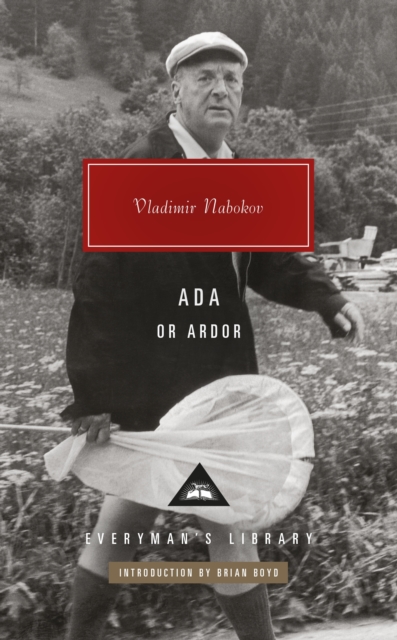
Ada
or Ardor
(Autor) Vladimir NabokovThis story of a man's lifelong entanglement with his sister is not only a love story; it manages also to be a fairy tale, an epic, a philosophical treatise on the nature of time, a parody of the history of the novel, and an erotic catalogue. It concludes with an ingeniously sardonic appendix by the author, written under the anagrammatic pseudonym Vivian Darkbloom. Ada, or Ardor, published just after Nabokov's seventieth birthday, is the supreme work of a virtuosic imagination at white heat. Nabokov is the most allusive and linguistically playful writer in English since Joyce, and like \"Pale Fire\" and \"Lolita,\" his new novel abounds in delightful minor parodies and pastiches, countless multilingual puns and literary jokes. Ada or Ardor is at its core a love story, the stuff that's sold reams of pop music, and piles of books. Van, fourteen, falls in love with twelve-year-old Ada during a summer vacation. This premise is possibly the only aspect of Ada or Ardor common to numerous other novels. Van, an unreliable narrator if there ever was one, tells the story, while the narrative shuttles seamlessly from a first person to a third person - trust Nabokov the Enchanter to achieve that trick.
Vladimir Nabokov
Vladimir Nabokov was a Russian-American novelist and lepidopterist known for his intricate writing style and innovative narrative techniques. His most notable works include "Lolita," a controversial novel that explored taboo themes with lyrical prose, and "Pale Fire," a complex and metafictional masterpiece. Nabokov's writing often featured wordplay, allusions, and unreliable narrators, challenging readers to engage with his work on multiple levels. His contributions to literature include expanding the possibilities of fiction and redefining the boundaries of the novel. Nabokov's impact on the literary genre of modernist and postmodernist literature is profound, influencing writers such as Salman Rushdie and David Foster Wallace. "Lolita" remains his most famous and enduring work, cementing his legacy as one of the great literary innovators of the 20th century.
Other related


Insomniac Dreams
Experiments with Time by Vladimir Nabokov