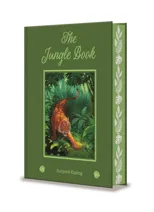
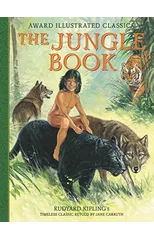
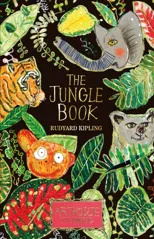
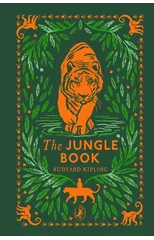
The Jungle Book
(Author) Rudyard KiplingAmong the best loved of all classics for children are the tales of Mowgli, the boy who learned the law of the jungle as he grew up among a pack of wolves in India's Seeonee Hills. First published in 1894, the book imagines a child living and flourishing in a community of animals - an idea that perhaps had its origin in Kipling's unhappy childhood. 'His stories are not animal stories in the realistic sense; they are wonderful, beautiful fairy tales, ' wrote Ernest Thompson Seton, the great Canadian naturalist. Kurt Wiese's illustrations, commissoned by the American firm of Doubleday in 1932, have never appeared in Britain before. An artist with a particular interest in animals and an amazing visual memory, he remembered all he had observed on his travels in the Far East during the early 1900s, first as a salesman in China and then as a prisoner-of-war of the Japanese.
Rudyard Kipling
Rudyard Kipling was a British author and poet, born in 1865 in Bombay, India. Known for his vivid storytelling and evocative prose, Kipling's most notable works include "The Jungle Book," "Kim," and the poem "If—." His writing often explored themes of colonialism, patriotism, and the human experience.
Kipling's unique blend of adventure, imagination, and moral complexity made him a significant figure in the development of the modern short story and children's literature. His impact on the literary genre can be seen in his influential use of language and his ability to capture the essence of the British Empire.
One of Kipling's most famous works, "The Jungle Book," remains a classic of children's literature and has been adapted into numerous films and stage productions. Rudyard Kipling's legacy continues to be celebrated for his innovative storytelling and enduring contributions to literature.
Other related