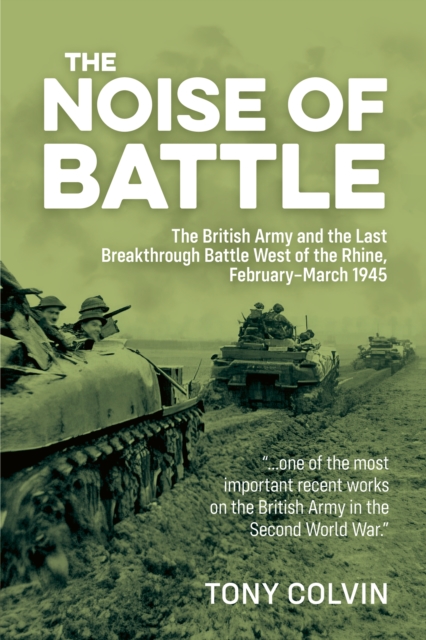
The Noise of Battle
The British Army and the Last Breakthrough Battle West of the Rhine, February-March 1945
(Author) Tony ColvinHalf of the book is a detailed description, mainly told in the words of participants, of three battles fought over four days in the Rhineland south of Goch between 27 February and March 2 1945. The battles were between 3rd Division supported by 6 Guards Armoured Brigade, and 8. Fallschirmjäger Division. For the first time the combined actions of over 50,000 men during 96 hours have been analysed from the ground up in an unprecedented attempt to provide understanding of a significant military event. 3 Scots Guards said of Winnekendonk, "It is suggested that this will surely rank as one of the finest small scale tank/infantry battles ever executed and well worthy of more close study." The fighting was bloody and heroic, and some controversial aspects are explained for the first time. The other half of the book is an analysis of the units and people involved in the two divisions and their supporting armour and aviation. An answer is provided as to why only two months before the end of hostilities, 21 Army Group could manage only quite slow and costly progress. The answer comes from the analysis, and is tested through comparison with the contemporary Canadian Operation Blockbuster, and with two battles in the Hitler Line. Evidence is provided that there is no truth to recent claims that Montgomery's generalship was efficient and saved lives. Instead, it is shown that the military hierarchy, including Churchill, ignored the all-arms operational methodology under unitary command which Sir John Monash had developed to bring victory in 1918. In the Second World War, by contrast, the Royal Armoured Corps and 2 TAF never integrated with the infantry and artillery, and were never suitably equipped, being bound to the cultic pursuit of mobility. General Elles required that the Infantry Tank be immune to all German anti-tank guns, and his Matilda II was a major reason for the deliverance from Dunkirk and for the success of Operation Compass in North Africa. Compared with the Hundred Days of 1918, the author suggests that the British Armed forces in 1945 were relatively less efficient in all respects except that of killing German civilians in area bombing. This book's fully documented and researched conclusions provide a new and controversial interpretation of 21 Army Group.
Tony Colvin
Other related

The Successor
Boris Nemtsov, Vladimir Putin and the Decline of Modern Russia

The Oak and The Larch
A Forest History of Russia and its Empires

Her Secret Service
The Forgotten Women of British Intelligence

War Without Mercy
A Pocket Essential History of the Spanish Civil War, 1936-1939

Tchaikovsky's Empire
A New Life of Russia's Greatest Composer