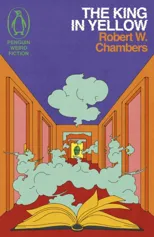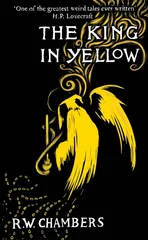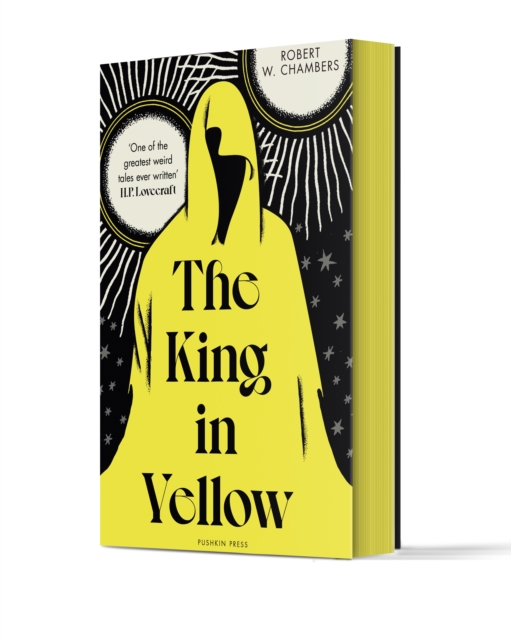
The King in Yellow
(Author) Robert W. ChambersA stunning new paperback edition of the supernatural horror cult classic of weird fiction that inspired H.P. Lovecraft and HBO’s True Detective—featuring gorgeous sprayed edges and an art deco design. 4 unforgettably unsettling tales about a play that drives its audiences to madness as it explores themes of the supernatural, spirituality, and the potentially corrosive influence of belief in the afterlife. I cannot forget Carcosa where black stars hang in the heavens; where the shadows of men's thoughts lengthen in the afternoon... I pray God will curse the writer, as the writer has cursed the world with this beautiful, stupendous creation, terrible in its simplicity, irresistible in its truth —a world which now trembles before the King in Yellow. Uncanny, macabre, and unsettling, the 4 tales contained in this beautiful new edition of Robert W. Chambers’s supernatural classic are arguably the greatest ever written in the weird fiction genre. They are linked together by a play, The King in Yellow, whose second act reveals truths so terrible and beautiful that it drives all who read it to bitter despair. Across each story, the book spreads like an infectious disease, from city to city, from continent to continent. Its wicked pages violate no definite principles, or doctrine. It cannot be judged by any known standard. Yet, although all acknowledge The King in Yellow as a supreme achievement of art, all feel that human nature cannot bear the strain, nor thrive, on words which in which the essence of purest poison lurks. Influencing generations of writers since their first publication in 1895, from the renowned master of cosmic horror H.P Lovecraft to the creators of HBO's True Detective, these stories are a rediscovered classic of weird fiction and supernatural horror.
Robert W. Chambers
Robert W. Chambers (1865-1933) was an American writer known for his contributions to the genre of weird fiction. His most notable work is "The King in Yellow," a collection of interconnected short stories that explore themes of madness, despair, and the supernatural. Chambers' writing style is characterized by its atmospheric and evocative prose, as well as its exploration of psychological horror and the unknown. He is considered a pioneer of the weird fiction genre, influencing authors such as H.P. Lovecraft and Stephen King. Chambers' legacy in literature is marked by his ability to create haunting and immersive worlds that continue to captivate readers to this day.
Other related
The King in Yellow & Other Tales of the Supernatural