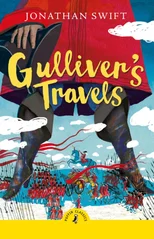
Gulliver's Travels
Into Several Remote Nations of the World: Complete and Unabridged
(Author) Jonathan SwiftGulliver's Travels has been called many things: Menippean satire, children's story, proto-Science Fiction and even the forerunner of the modern novel. Published seven years after Daniel Defoe's wildly successful Robinson Crusoe, Gulliver's Travels may be read as a rebuttal of Defoes optimistic account of human capability. In The Unthinkable Swift: The Spontaneous Philosophy of a Church of England Man Warren Montag argues that Swift was concerned to refute the notion that the individual precedes society, as Defoe's novel seems to suggest. Swift regarded such thought as a dangerous endorsement of Thomas Hobbes' radical political philosophy and for this reason Gulliver repeatedly encounters established societies rather than desolate islands. The captain who invites Gulliver to serve as a surgeon aboard his ship on the disastrous third voyage is named Robinson. Possibly one of the reasons for the book's classic status is that it can be seen as many things to many different people. Wilder Publications is a green publisher. All of our books are printed to order. This reduces waste and helps us keep prices low while greatly reducing our impact on the environment.
Jonathan Swift
Jonathan Swift (1667-1745) was an Irish writer and clergyman known for his satirical works that critiqued society and politics. His most famous work, "Gulliver's Travels," is a biting satire on human nature and the flaws of society. Swift's writing is characterized by wit, irony, and a keen eye for social commentary. He was a master of the satire genre, using humor and exaggeration to shed light on the absurdities of his time. Swift's contributions to literature have had a lasting impact on the genre of satire, influencing countless writers and thinkers.
Other related