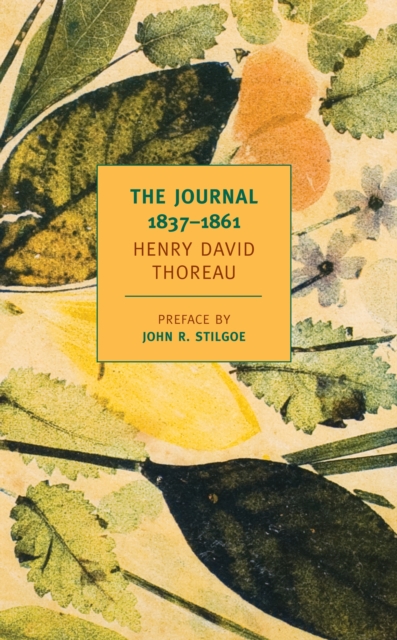
The Journal 1837-1861
(Author) Henry David ThoreauHenry David Thoreau’s Journal was his life’s work: the daily practice of writing that accompanied his daily walks, the workshop where he developed his books and essays, and a project in its own right—one of the most intensive explorations ever made of the everyday environment, the revolving seasons, and the changing self. It is a treasure trove of some of the finest prose in English and, for those acquainted with it, its prismatic pages exercise a hypnotic fascination. Yet at roughly seven thousand pages, or two million words, it remains Thoreau’s least-known work. This reader’s edition, the largest one-volume edition of Thoreau’s Journal ever published, is the first to capture the scope, rhythms, and variety of the work as a whole. Ranging freely over the world at large, the Journal is no less devoted to the life within. As Thoreau says, “It is in vain to write on the seasons unless you have the seasons in you.”
Henry David Thoreau
Henry David Thoreau was an American essayist, poet, and philosopher known for his transcendentalist beliefs and writings on nature, simplicity, and civil disobedience. His most notable works include "Walden," a reflection on living a simple life in harmony with nature, and "Civil Disobedience," a call for individual resistance to unjust laws.
Thoreau's writing style is characterized by its introspective and philosophical nature, as well as its vivid descriptions of the natural world. His works have had a lasting impact on environmental literature and the development of the conservation movement. "Walden" remains his most famous work, exploring themes of self-reliance, individualism, and the importance of living deliberately. Thoreau's contributions to literature continue to inspire readers to seek a deeper connection with nature and live more intentionally.
Other related



The Daily Henry David Thoreau
A Year of Quotes from the Man Who Lived in Season