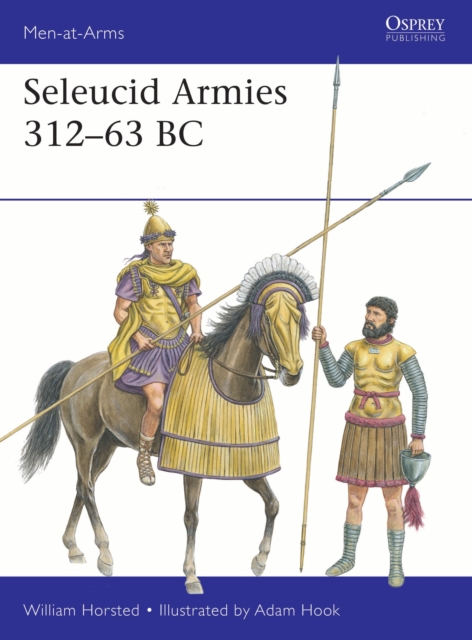
Seleucid Armies 312–63 BC
(Author) William HorstedThis colourful study describes and illustrates the troops of the Seleucid Empire in West Asia throughout its turbulent 250-year existence. Founded by the Macedonian general Seleucus I Nicator in 312 BC in the wake of the death of Alexander the Great 11 years previously, the Seleucid Empire came to control much of the territory conquered by Alexander in western Asia, and at its height reached from the Mediterranean to Afghanistan. The colourful armies fielded by Seleucus I and his successors are described and illustrated in this absorbing study of a major power at war in the ancient world. As the fortunes of their realm ebbed and flowed, Seleucid kings deployed vast armies recruited from diverse peoples that drew upon an array of military traditions, including the mighty phalanx, war elephants, scythed chariots and camel-mounted archers. Illustrated throughout with photographs and drawings as well as eight pages of specially commissioned artwork, this fascinating study draws upon a range of literary, archaeological and artistic sources to explore the organization, tactics, weapons and equipment of the varied units of Seleucid armies over two-and-a-half turbulent centuries in the ancient world.
William Horsted
William Horsted was a British poet known for his epic poem "The Triumphs of Love." His lyrical style and vivid imagery captivated readers, earning him a reputation as a master of Romantic poetry. Horsted's work explored themes of love, nature, and the human experience, influencing generations of poets to come.
Other related
Caesarian Legionary vs Pompeian Legionary
Rome’s Civil War 49–45 BC

British Celtic Warrior vs Roman Soldier
Britannia AD 43–105