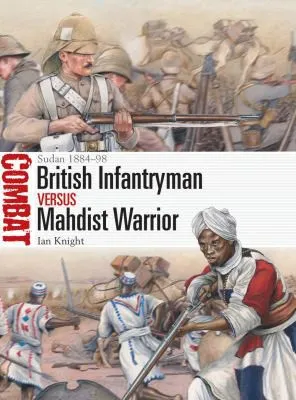
British Infantryman vs Mahdist Warrior
Sudan 1884–98
(Author) Ian KnightA new study of the battles fought between Queen Victoria's infantry and the formidable Madhist Army in the Sudan, from the Gordon Relief Expedition of 1884–85 to the battles of Atbara and Omdurman in 1898. In the early 1880s, Britain intervened in independent Egypt and seized control of the Suez Canal. British forces were soon deployed to Egypt's southern colony, the Sudan, where they confronted a determined and capable foe amid some of the world's most inhospitable terrain. In 1881 an Islamic fundamentalist revolt had broken out in the Sudan, led by a religious teacher named Muhammad Ahmad bin Abd Allah, who proclaimed himself al-Mahdi, "The Guided One." In 1884, Mahdist forces besieged the Sudanese capital of Khartoum; Colonel Charles Gordon was sent to the city with orders to evacuate British personnel, but refused to leave. Although the British despatched a relief column to rescue Gordon, the Mahdists stormed Khartoum in January 1885 and he was killed. British troops abandoned much of the Sudan, but renewed their efforts to reconquer it in the late 1890s, in a bloody campaign that would decide the region's fate for generations. Written by leading expert Ian Knight, this fully illustrated study examines the evolving forces, weapons and tactics employed by both sides in the Sudan, notably at the battles of Abu Klea (January 16–18, 1885), Tofrek (March 22, 1885), and Atbara (April 8, 1898).
Ian Knight
Ian Knight is a renowned British military historian known for his extensive research on the Anglo-Zulu War. His most famous work, "The Anatomy of the Zulu Army," revolutionized the understanding of Zulu military tactics. Knight's detailed and insightful writing style has made him a leading authority on 19th-century colonial conflicts.
Other related




Boer Guerrilla vs British Mounted Soldier
South Africa 1880–1902