
Arab Armour vs Israeli Armour
Six-Day War 1967
(Author) Chris McNabA detailed study of one of the greatest tank battles since World War II, as some 950 Egyptian tanks confronted about 800 tanks of the Israeli Defense Forces (IDF) in the Sinai Peninsula. This momentous clash came to be known as the Six-Day War, and was a critical laboratory for two competing and contrasting systems of armored warfare. The Six-Day War in 1967 was a lightning Israeli campaign that changed the face of the Middle East. Israel's armored brigades, despite being heavily outnumbered on paper by Arab AFVs, managed to dominate the Arab forces tactically and technologically, through excellent gunnery and decentralized battlefield leadership. The fighting took place on three different fronts: the Sinai Front, the Jordanian Front and the Golan Heights. Each presented its own unique set of tactical and terrain challenges, from the long-range battles between massed Egyptian and Israeli armor in the scorching flatlands of the Sinai Desert, to relatively close-quarters engagements across steep and narrow terrain in the Golan Heights. Not only did the Six-Day War see the direct clash of opposing Cold War tactical approaches, but also the direct confrontation of Western and Soviet MBTs. On the Israeli side, the IDF had the British Centurion, the American M48 Patton, the M51 Super Sherman, and the French AMX-13, although they focused their armored spearheads on the Centurions and Pattons. The Arabs' armored power was expressed through T-34/85s, T-54/55s, PT-76s and JS-3s (IS-3s). Each vehicle brought its own set of advantages and disadvantages, although ultimately it was the long-range tank-killing gunnery of the Centurion that often took the day. Drawing on compelling first-hand accounts from both unit commanders and individual crews, this Duel title explains the tactical and mechanical dynamics of one of history's greatest post-war armored engagements.
Chris McNab
Chris McNab is a British writer and historian known for his expertise in military history and weaponry. He has authored over 100 books on a wide range of topics, including the history of warfare, special forces, and military tactics. McNab's writing style is characterized by his thorough research, detailed analysis, and engaging storytelling.
One of his most notable works is "The Illustrated History of the Vietnam War," which provides a comprehensive overview of the conflict and its impact on the world. McNab's contributions to literature include shedding light on lesser-known aspects of military history and highlighting the experiences of soldiers on the frontlines.
McNab's impact on the literary genre of military history is significant, as he has brought attention to important events and individuals that have shaped the course of warfare. His ability to make complex historical topics accessible to a wide audience has earned him a reputation as a respected authority in the field of military history.
Other related
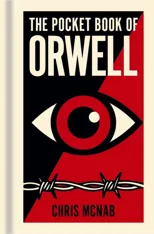
The Pocket Book of Orwell
A Concise Introduction to Orwell’s Writings and Ideas

Secret Weapons of World War II
The Undercover Innovations in Military Armaments, 1939-45


Stephen Hawking
The Theoretical Physicist Who Shaped Our View of the Cosmos

World War II Encyclopedia of Aircraft, Tanks & Warships
Over 1200 Illustrations
