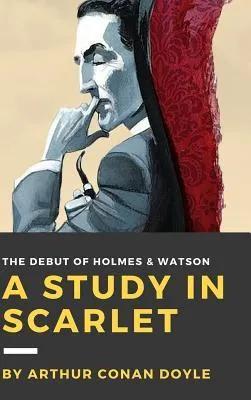
A Study in Scarlet
(Author) Sir Arthur Conan DoyleDr. Watson, a military surgeon lately returned from the Afghan War, needs a flat-mate and a diversion. Sherlock Holmes needs a foil. And thus a great literary collaboration begins. Then murder. Facing a deserted house, a twisted corpse with no wounds, a mysterious phrase drawn in blood on the wall, and the buffoons of Scotland Yard--Lestrade and Gregson--Holmes measures, observes, picks up a pinch of this and a pinch of that, and generally baffles his faithful Watson. Later, Holmes explains: ""In solving a problem of this sort, the grand thing is to be able to reason backward.... There are few people who, if you told them a result, would be able to evolve from their own inner consciousness what the steps were which led up to that result."" Sherlock Holmes is one of those people.
Sir Arthur Conan Doyle
Sir Arthur Conan Doyle was a British writer and physician, best known for creating the iconic detective character Sherlock Holmes. His most notable works include the Sherlock Holmes series, featuring novels such as "A Study in Scarlet" and "The Hound of the Baskervilles." Doyle's writing style is characterized by intricate plots, meticulous attention to detail, and clever deductions that have influenced the detective genre for generations to come. His contributions to literature include popularizing the detective story and creating one of the most enduring and beloved fictional characters in history. "The Adventures of Sherlock Holmes" remains his most famous work, showcasing his talent for crafting compelling mysteries and memorable characters. Doyle's impact on literature is immeasurable, as his works continue to inspire countless adaptations, tributes, and homages in various forms of media.
Other related

The Adventures & Memoirs of Sherlock Holmes (Deluxe Edition)