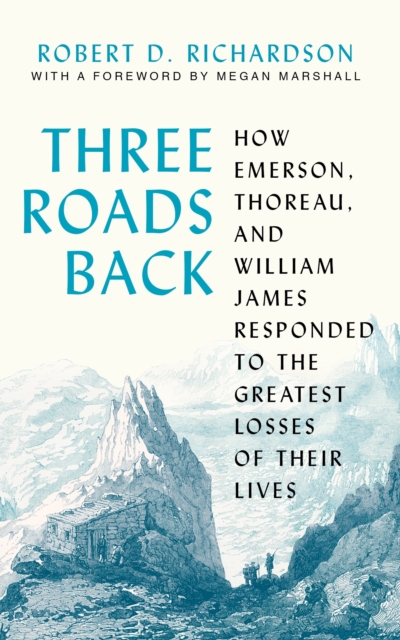
Three Roads Back
How Emerson, Thoreau, and William James Responded to the Greatest Losses of Their Lives
(Author) Robert D. Richardson"This book explores resilience by tracing the linked stories of how Ralph Waldo Emerson, Henry David Thoreau, and William James dealt with personal tragedy: for Emerson, the death of his young wife and, eleven years later, his five-year-old son; for Thoreau, the death of his brother; and for James, the death of his beloved cousin Minny. Weaving together biographical detail with quotations from the writers' journals and letters, Richardson shows readers how each of these writers grappled with loss and grief and ultimately achieved a level of resilience. Emerson lost his Unitarian faith but found solace in the study of nature; Thoreau leaned on the natural world's capacity for regeneration, and the comparatively small role played by individual persons; James lit upon a notion of self-governance and emotional malleability that would underwrite much of his work as a psychologist and philosopher. All three, Richardson suggests, emerged from their grief with a new way of seeing, one shaped by a belief in, as Emerson would write, "the deep remedial force that underlies all facts.""--
Robert D. Richardson
Robert D. Richardson was an esteemed American biographer known for his Pulitzer Prize-winning work, "Emerson: The Mind on Fire." His literary style is characterized by meticulous research and insightful analysis, shedding light on the lives of prominent literary figures. Richardson's contributions to literature include illuminating the inner workings of iconic authors.
Other related