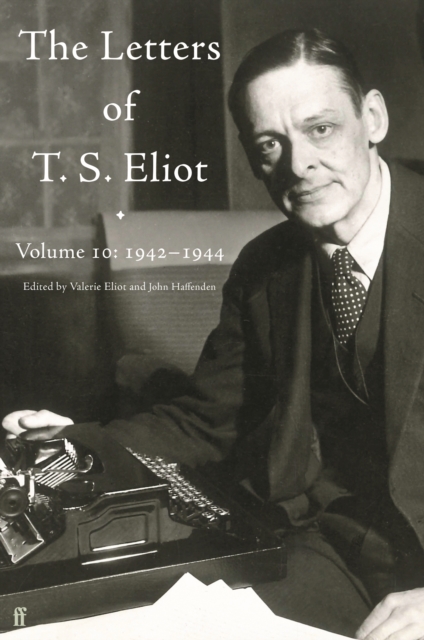
Letters of T. S. Eliot Volume 10
1942–1944
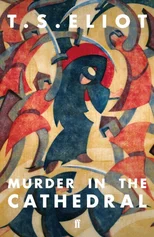
(Author) T.S. Eliot'What is accomplished by this sort of cultural warfare is impossible to say: but it [is] a part of total warfare which one must, as an individual, accept one's part in.' At the height of the Second World War, T. S. Eliot commits himself to fighting for the cultural values of Europe. He goes on a lecture tour of Sweden; he writes talks for the BBC; he reads poems for the Czechoslovak Centre, for 'Aid to Russia' and for the 'French in Britain Fund'. He lectures on 'The Music of Poetry' in Glasgow; addresses the Classical Association; talks at the 'Moot', and visits organisations including the Anglo-Swedish Society and the British-Norwegian Institute; and he works for the Christian News-Letter. He serves as President of the English Circle of 'Books Across the Sea' and as first President of the Virgil Society. He feels exhausted by travel and performance but remains stalwart. And always there is the threat in London - he has 'no regular habitation' - of being bombed: 'I have taken . . . to sleeping in my teeth.' Contacts and correspondents during these dark days include the film director George Hollering for whom he struggles to adapt his play Murder in the Cathedral, Kenneth Clark, Henry Moore, David Jones, William Empson, Mary Trevelyan, Karl Mannheim, Louis MacNeice, Elizabeth Bowen, M. J. Tambimuttu, Edith Sitwell and Reinhold Niebuhr. Notable poets recruited to the Faber fold include Lawrence Durrell, Anne Ridler and Norman Nicholson. Eliot's own creative energies are focused on completing Little Gidding, the final poem of the supernal sequence Four Quartets. The series of letters to John Hayward, who advises him, is a tour de force of the art: full of news, merriment and mischief.
T.S. Eliot
T.S. Eliot (1888-1965) was a highly influential poet, essayist, and playwright of the 20th century. His most notable works include "The Love Song of J. Alfred Prufrock," "The Waste Land," and "Four Quartets." Eliot's literary style was characterized by its complexity, symbolism, and exploration of themes such as identity, alienation, and the search for meaning in a fragmented world. He is credited with revolutionizing modern poetry through his innovative use of language, form, and imagery. Eliot's impact on the literary genre of modernism is profound, as he challenged traditional poetic conventions and paved the way for future generations of poets to experiment and push boundaries. His most famous work, "The Waste Land," is considered a landmark in 20th-century literature for its exploration of the disillusionment and despair of post-World War I society. Eliot's contributions to literature continue to be celebrated and studied for their enduring relevance and influence on the literary canon.
Other related