Bacteria to AI
Human Futures with our Nonhuman Symbionts
(Author) N.Katherine Hayles"Humans are driving the planet toward catastrophe, and yet humans are the only species capable of taking positive actions on a global scale to prevent collapse. For N. Katherine Hayles, human hubris and the anthropocentrism that underlies it is one of the main drivers of our current planetary crises. So, if we are to take action to save the planet, we urgently need to re-think basic assumptions about agency, decision-making, control, and our relations to nonhuman and artificial cognizers. In Bacteria to AI, Hayles develops an integrated cognitive framework (ICF) that includes humans, nonhuman lifeforms, and some computational media, including artificial intelligence. Bacteria to AI analyzes how the first-order emergences of physical phenomena, multicellularity, and technics are now interacting together to create second-order emergences that greatly accelerate technical developments. The book explores these entanglements through case studies ranging from gene editing to autopoiesis and Gaia theory, bacteria and xenobots to artificial intelligence. Spanning evolutionary biology, artificial intelligence, and contemporary literature, Bacteria to AI recognizes the risks of contemporary technologies but insists a positive way forward, with ICF at its core, is possible for us and for the more than human world"--
N.Katherine Hayles
N. Katherine Hayles is a renowned literary critic and scholar known for her work in the fields of posthumanism, digital humanities, and electronic literature. She has authored several influential books, including "How We Became Posthuman" and "My Mother Was a Computer: Digital Subjects and Literary Texts." Hayles' writing style is characterized by its interdisciplinary approach, blending literary theory, science, and technology to explore the changing nature of human identity in the digital age. Her work has had a significant impact on the study of literature and technology, challenging traditional notions of the human subject and pushing the boundaries of literary analysis. Her most famous work, "How We Became Posthuman," is considered a seminal text in the field of posthumanism and has shaped discussions around the relationship between humans and technology in contemporary society.
Other related
How We Became Posthuman
Virtual Bodies in Cybernetics, Literature, and Informatics

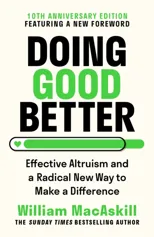
Doing Good Better
Effective Altruism and a Radical New Way to Make a Difference

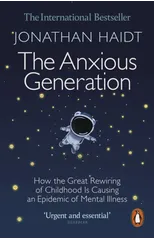
The Anxious Generation
How the Great Rewiring of Childhood Is Causing an Epidemic of Mental Illness