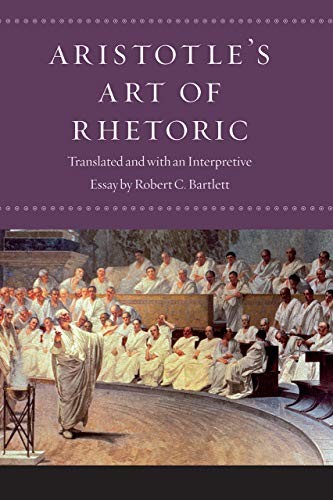
Aristotle's "Art of Rhetoric"
(Author) AristotleFor more than two thousand years. Aristotle’s “Art of Rhetoric” has shaped thought on the theory and practice of rhetoric, the art of persuasive speech. In three sections, Aristotle discusses what rhetoric is, as well as the three kinds of rhetoric (deliberative, judicial, and epideictic), the three rhetorical modes of persuasion, and the diction, style, and necessary parts of a successful speech. Throughout, Aristotle defends rhetoric as an art and a crucial tool for deliberative politics while also recognizing its capacity to be misused by unscrupulous politicians to mislead or illegitimately persuade others. Here Robert C. Bartlett offers a literal, yet easily readable, new translation of Aristotle’s “Art of Rhetoric,” one that takes into account important alternatives in the manuscript and is fully annotated to explain historical, literary, and other allusions. Bartlett’s translation is also accompanied by an outline of the argument of each book; copious indexes, including subjects, proper names, and literary citations; a glossary of key terms; and a substantial interpretive essay.
Aristotle
Aristotle was a Greek philosopher and polymath known for his work "Poetics," a seminal treatise on literary theory and the art of poetry. His writing style is characterized by clarity, logic, and precision. Aristotle's contributions to literature include defining the elements of drama and analyzing the structure of storytelling.
Other related
Aristotle's Chemistry
On Coming to Be and Passing Away Meteorology 1.13, 4.112