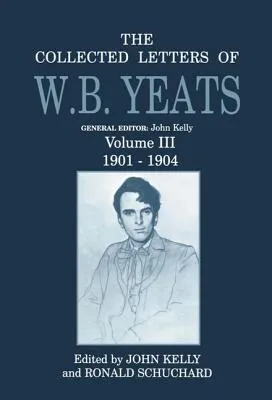
The Collected Letters of W. B. Yeats
Volume III: 1901-1904
(Author) W.B. YeatsThe first two volumes of Yeats's collected letters met with enormous critical acclaim. This third, like the others, presents the letters complete with characteristic misspellings and peculiar punctuation, and gives a full flavour of his idiosyncrasy and haste as a correspondent. The letters are in themselves fascinating and highly revealing of the man behind the poetry. They show both the political fervour and the poetic sensibility, and represent Yeats as friend, adversary, critic, and man passionately involved in the state of Ireland, culturally and politically. These are the years which saw the setting-up of the Abbey Theatre in Dublin, as the permanent home of the Irish National Theatre Company run by his friends the Fays. Annotation is particularly full and far-reaching, supplying a wealth of hitherto unresearched information about the background to the letters, and in itself adding very considerably to what is known of Yeats and his circle. There is a biographical register of the main figures who appear in the volume, and a full index.
W.B. Yeats
W.B. Yeats was an Irish poet, playwright, and one of the most prominent figures of 20th-century literature. Known for his lyrical and mystical poetry, Yeats's works often explored themes of mythology, symbolism, and the occult. Some of his most notable works include "The Tower," "The Wild Swans at Coole," and "The Second Coming."
Yeats played a significant role in the Irish Literary Revival and was a key figure in the development of modernist poetry. His poetic style combined traditional Irish folklore with modernist techniques, creating a unique and influential body of work that continues to inspire generations of poets and writers.
One of Yeats's most famous works is "The Lake Isle of Innisfree," a poem that reflects his deep connection to the Irish landscape and his longing for a simpler way of life. Yeats's contributions to literature, his innovative style, and his enduring influence make him a towering figure in the world of poetry and literature.
Other related

The Irish Folk and Fairy Tales Collection
5-Book Paperback Boxed Set
W. B. Yeats
An inspiring collection from one of Ireland’s greatest literary figures